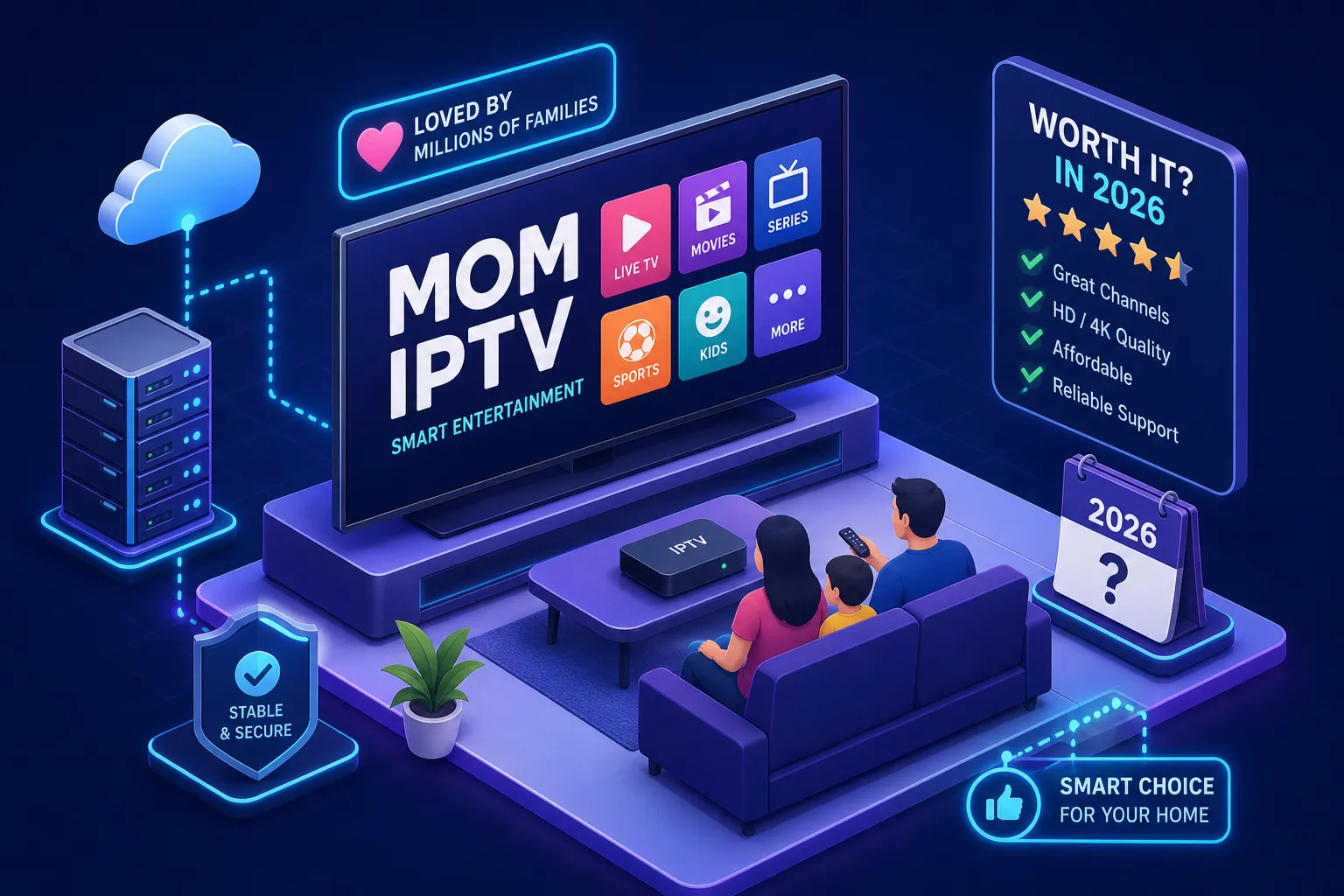
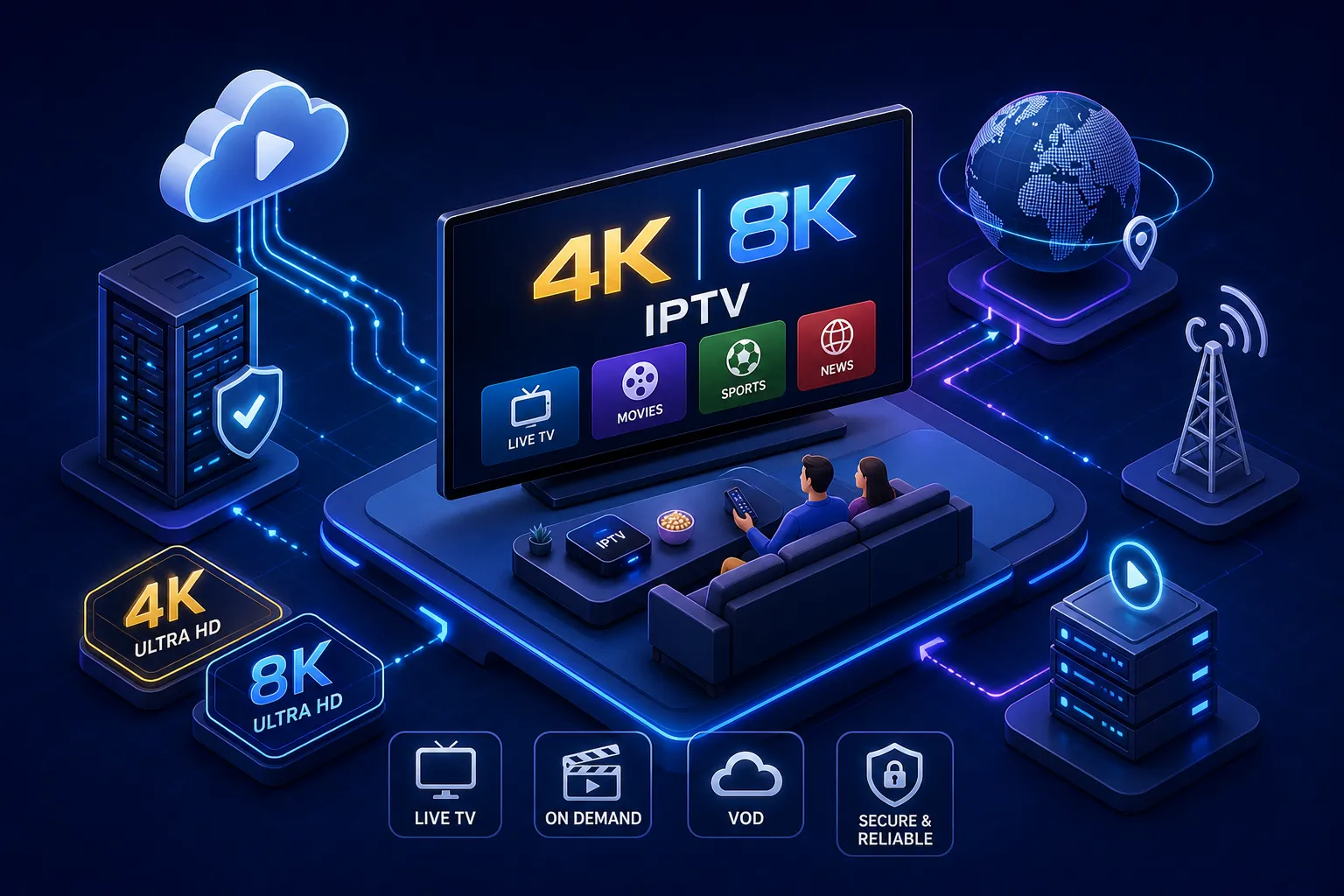
If you’re searching for the best IPTV in 2026 to replace a bloated cable bill, you’re not alone. Pay-TV prices have climbed steadily for years, and the average US household now manages multiple paid streaming subscriptions just to cover everything they want to watch, yet free apps still buffer during the moments that matter most. More Americans are exploring IPTV subscriptions as a genuine cable replacement, and the savings can be substantial. The challenge is that the market is crowded with providers making big promises and delivering inconsistent results.
This guide ranks the top-rated IPTV services available right now based on channel count, streaming quality, pricing, reliability, and customer support. After testing and comparing the field, one provider, Mom IPTV, consistently earns the top spot in our evaluation, and by the time you finish reading, you’ll understand exactly why.
What separates a great IPTV service from a forgettable one
Channel count is the first thing most buyers look at, but it tells only part of the story. A service advertising 22,000+ live channels delivers a fundamentally different experience than one offering 200 channels, not just in volume, but in sports coverage and international programming. For sports fans, multicultural households, and anyone who wants real cable-replacement depth, that distinction matters enormously.
Stream quality and buffer-free technology
Stream quality is where most providers fall short, especially during live events. Many paid IPTV services run on shared server infrastructure that buckles under traffic during a championship game or prime-time broadcast. The result is buffering, stream drops, and the kind of frustration that sends people back to cable. Premium providers use dedicated, load-balanced infrastructure with anti-freeze technology to handle traffic spikes without interrupting playback. This is the technical feature that separates reliable services from the rest, and it should be the first thing you ask about before subscribing.
Pricing transparency and support responsiveness
A fair price range for a single-connection IPTV subscription in 2026 typically runs roughly $13 to $20 per month, based on pricing across major providers currently in the market. Anything significantly lower deserves scrutiny regarding content licensing. What you get when something goes wrong matters just as much as the monthly cost. Real customer support means 24/7 availability with fast responses via WhatsApp or live chat. A ticket system that responds in three days is a liability when your stream drops during an NFL playoff game.
Best IPTV services of 2026: the ranked picks
The services below were evaluated on channel count, stream reliability, pricing structure, device compatibility, and support responsiveness. For this IPTV review of 2026 options, the gaps between providers are significant, and the ranking reflects that.
How to choose the best IPTV service for your needs
Before diving into individual rankings, it helps to know what criteria matter most for your situation. Sports viewers should prioritize anti-freeze infrastructure and live channel depth. Budget-conscious single-user households may value flexible trial policies. Multi-device families need to look closely at per-connection pricing structures before committing. The sections below address each of these scenarios directly.
#1 Mom IPTV: the channel and reliability benchmark
Mom IPTV earns the top spot because it hits every benchmark that matters. The service delivers 22,000+ live channels covering sports, news, entertainment, and international content, plus a VOD library of over 120,000 movies and TV series, figures drawn from the provider’s official channel listings. Stream quality options include HD, FHD, UHD, and 4K, and the service runs on anti-freeze server infrastructure designed to keep streams stable during peak traffic. Activation is handled through your account credentials and compatible apps, no hardware installation required.
Plans start at around $14 per month, with 1-month, 3-month, 6-month, and 12-month options available. Multi-device tiers let households run multiple screens simultaneously without the per-device pricing penalties common with other providers. Mom IPTV advertises a 7-day money-back guarantee, which gives you time to evaluate the service before fully committing. Most importantly, Mom IPTV offers 24/7 customer support via WhatsApp, which means real answers when you need them. Compatible devices include Firestick, Smart TV, Android TV, iOS, and IPTV Smarters Pro.
#2 RealmIPTV: a solid mid-tier option
RealmIPTV is a serviceable option for single-user setups on a tight budget. Pricing starts at $13.99 per month for one device, and the service offers a 24-hour free trial with no credit card required, a genuinely useful way to test before committing. Longer plans are available at $29.99 for 3 months and $74.99 for 12 months on a single connection.
The main limitation is the per-device pricing model. Two screens run $24.99 per month, scaling to $35.99 for three and $54.99 for five, costs that add up fast for families. Based on publicly available documentation, RealmIPTV does not advertise a dedicated anti-freeze infrastructure, and its channel selection is smaller than what Mom IPTV offers. It’s a reasonable starting point for someone testing IPTV for the first time on a single device, but it doesn’t scale well.
#3 Zenora IPTV and other notable providers
Zenora IPTV accepts PayPal, credit cards, and cryptocurrency, which is a positive sign for payment flexibility. EagleCast is another provider in this tier that accepts Apple Pay, Google Pay, Cash App, and crypto. Both are functional options for straightforward single-user streaming. Per available documentation, neither advertises the channel depth, dedicated anti-freeze infrastructure, or real-time support model that distinguish Mom IPTV at the top of this comparison. For users without demanding live sports requirements, either can get the job done.
Pricing breakdown: what each plan actually gets you
Choosing the cheapest monthly option often costs more over time than committing to a longer plan upfront. Mom IPTV’s 6-month and 12-month plans reduce the effective monthly cost considerably, a smarter choice for anyone who plans to use the service consistently. RealmIPTV’s $13.99 entry point looks competitive until you factor in multi-device pricing, which escalates quickly for households running more than one screen.
Trial policies and money-back guarantees
A legitimate IPTV provider stands behind its service with a real trial or refund window. Mom IPTV advertises a 7-day money-back guarantee, which gives you enough time to test stream quality, channel coverage, and device compatibility before committing. RealmIPTV provides a 24-hour free trial with no credit card required, which is a lower-friction entry point for first-timers. Any provider that offers no trial, no refund policy, and no way to test the service before paying full price should be avoided entirely, regardless of how compelling the marketing looks.
Streaming reliability and buffer-free performance
Buffering is the single most common complaint about IPTV services in 2026. It spikes during peak hours, evenings, weekends, and especially during live sports. Documented outages have affected even established streaming platforms like Hulu Live and YouTube TV during high-traffic events like NFL playoff windows, and those services run on far more established infrastructure than most IPTV providers. The bar for acceptable reliability is higher than most buyers realize going in.
Anti-freeze technology and what it means for your stream
Anti-freeze technology is not a single feature; it’s a set of server-side and delivery techniques working together. Adaptive bitrate streaming adjusts video quality in real time based on your connection without stopping playback. Load balancing distributes traffic across multiple servers so no single node gets overwhelmed during a big game. CDN edge delivery places stream segments on nearby servers to cut latency, while automatic failover reroutes your session to a backup node if the primary server slows down. Together, these components allow a well-built system to absorb demand spikes rather than buckle under them.
For live sports viewers, this infrastructure is what makes or breaks a service during a championship moment. You might see a brief quality dip during an extreme traffic event, but the stream stays alive. Mom IPTV advertises its anti-freeze server architecture as built around this model, making it the best IPTV subscription option for viewers who can’t afford dropped streams when it counts.
Matching the right IPTV service to your setup
Not every household needs the same thing from a streaming service. The right pick depends on your primary use case, your device setup, and whether you need international content. Here’s how the top options break down across three common viewer profiles.
Best for sports fans and live event viewers
Live sports demand the lowest latency and most stable streams available. NFL, NBA, boxing, international soccer leagues, and regional sports networks all require consistent uptime during high-traffic windows. Mom IPTV’s anti-freeze infrastructure and 22,000+ channel library, which includes both domestic and international sports coverage, make it the top pick for this use case. Other providers in this tier often hit their limits during playoff games and premium events, when demand is highest and margin for error is lowest.
Best for international and multicultural households
Mainstream services like Hulu and YouTube TV offer limited international-language channel options compared with many IPTV international lineups. That gap is exactly where IPTV services built around global content libraries excel. Mom IPTV’s international channel coverage spans Latin America, the Middle East, Europe, and Asia, giving multicultural households access to native-language content that major US streaming platforms don’t consistently provide. For immigrant families and expats living in the US, this is often the primary reason to switch, and a strong argument for choosing the best IPTV provider with genuine international depth.
Best for multi-device and tech-savvy streamers
Households running Firestick, Smart TV, Android TV boxes, iOS, and IPTV Smarters Pro simultaneously need a service that supports multi-connection plans without punishing them financially. Mom IPTV multi-device tiers are structured for this, keeping costs predictable across screens. RealmIPTV per-device model runs $35.99 per month for three connections, while Mom IPTV equivalent tier is priced more competitively. For tech-savvy streamers who want maximum device flexibility without stacking costs, the comparison is straightforward.
What to know before you subscribe to any IPTV service
A few practical considerations can protect you from costly mistakes. One of the most common errors new subscribers make is paying full price for a service without verifying its trial or refund policy, then discovering buffering issues only after the window to request a refund has closed. The factors below are worth checking before you hand over payment information to any provider.
M3U IPTV compatibility and app setup
Many IPTV services deliver streams via M3U playlists, a standard playlist format that works with a wide range of third-party apps including IPTV Smarters Pro, TiviMate, and VLC. When a provider gives you an M3U IPTV link, you load it into your app of choice, and it pulls in your full channel list automatically. This approach gives tech-savvy users flexibility to choose their preferred app interface, and it’s worth confirming that any IPTV service you’re evaluating supports M3U delivery if you plan to use a specific player.
IPTV legality in the United States
IPTV as a technology is fully legal in the United States. The legal question centers on what content is being streamed and whether the provider holds proper licensing rights. A compliant provider has documented distribution agreements, transparent company information, and pricing that reflects the actual cost of licensed content. Evaluate any IPTV service you’re considering against those factors independently, because content licensing varies by provider and territory.
Payment methods and red flags to avoid
Reputable IPTV providers accept standard payment methods. Mom IPTV accepts PayPal, Stripe, Bitcoin, and credit cards. Zenora and EagleCast accept similar options including crypto and mainstream payment apps. The warning sign to watch for is a provider that refuses credit cards and PayPal entirely and instead demands gift cards, wire transfers, or Western Union payments. No legitimate streaming service operates on gift card payments only. A real refund policy and mainstream payment acceptance are the baseline you should require from any provider before subscribing.
The bottom line on finding your best IPTV setup
The benchmarks are clear: a top-tier IPTV service in 2026 delivers 22,000+ live channels, anti-freeze streaming infrastructure, multi-device compatibility, and 24/7 human support, starting at around $14 per month. Based on its advertised features and how it compares across each of those criteria, Mom IPTV stands out as the strongest option in any honest comparison of best IPTV providers, on channel depth, infrastructure, and support availability.
Mom IPTV’s advertised 7-day money-back guarantee eliminates the financial risk of trying it. Get it running on your Firestick or Smart TV, put it through a weekend of live sports or international channels, and judge the stream quality against whatever you were paying for before. Switching from cable to a reliable IPTV subscription doesn’t have to be complicated, and with the right provider, it won’t be.